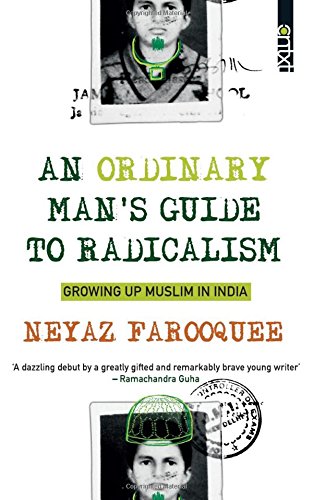
An Ordinary Man's Guide to Radicalism: Growing up Muslim in India
Price: [price_with_discount]
(as of [price_update_date] - Details)

[ad_1]
I heard many people saying that one of the terrorists had studied in Jamia School, in my batch. If ‘they’ were to say I was friends with him, how would I deny it? I had very few friends in school, but who would believe that?
You can alter your future, but how do you change your past?
19 September 2008, the Batla House encounter. That one day changed the life of a young man from Inderwan Bairam in Bihar’s Gopalganj district. An over-protected childhood in the village, an ambitious migration to Delhi as a young boy for better education, an undisciplined and shiftless adolescence – all of this history is flattened out into one tiny slice of Neyaz Farooquee’s identity: Muslim. From Jamia Nagar. Who lived practically next door to the Terrorists who had been killed in the encounter. A Potential Terrorist himself? How, after all, does a man prove that he is (and not merely pretending to be) a Normal Human Being?
Sardonic and wise, Farooquee scrapes out the unvarnished truth about identity and stereotypes, about life in a ghetto, and the small and big disappointments that make up an ordinary life.
A necessary book for our troubled times.
PRAISE FOR THE BOOK
‘Farooquee has achieved in this book what writers such as Ta-Nehisi Coates have done for Blacks in America, making voices of the marginalised minority heard. Both the author and the publisher (the book was written using a grant from the New India Foundation) deserve praise for addressing this subject at a time when communal polarisation has deepened across the country.’-The Hindu
‘The book certainly brings some sense of closure on a personal level, but a lot remains to be written- and justice for most disadvantaged sections of our society remains elusive.’-The Times of India
‘Neyaz Farooquee’s An Ordinary Man’s Guide to Radicalism: Growing Up Muslim in India is a poignant reflection on these and such other existential dilemmas facing India’s largest minority. Farooquee is a welcome addition to the tribe of young writers whose work is immersed in the lived realities of ordinary people.’-Open
‘Farooquee’s memoir is novel in the sense that it inaugurates a subgenre as there are hardly any platforms where the Indian Muslim experience has been articulated as clearly and candidly as it has been in this book.’-Frontline
‘Farooquee's book is not just an examination of the assumptions others make about Muslims. It is also, at its best, an interrogation of the assumptions that many Muslims make.’-India Today
‘Farooquee successfully emphasizes the increasing social segregation on communal lines in urban India. The book is a welcome addition to the corpus of literature that helps us understand the fears and insecurities of Indian Muslims and their sense of victimization at the hands of both the State and the media.’-The Telegraph
‘Revolving around the theme of Muslim vulnerabilities in India, Farooquee’s book opens up a Pandora’s Box, raising questions on crucial issues of power and class, identity and suspicion, nationality and citizenship and, importantly, the rhetoric of political ‘appeasement’ and actual deliverance.’-Dawn
‘The memoir, tries to clear the many myths and stereotypes about Muslims in India and highlights the diversity within the community and their lived reality.’-Al Jazeera
From the Publisher

Excerpt from an Ordinary Man’s Guide to Radicalism
It’s been over a decade since the encounter, but the questions remain. Were they really terrorists? If not, then gross injustice was done to them, their families, their friends. If yes, then there was gross injustice done to Inspector Sharma, his family, his friends, and those killed in the bomb blasts. In what circumstances was the inspector shot? Was he shot by the men inside the flat? Was he shot in friendly fire? The track record of the police team involved in the encounter, the special cell of the Delhi police, was hardly spotless, if one were to go by media reports. There had been several allegations of the cell’s involvement in questionable encounters.
What’s the complete truth? No one knows. Truths are as diverse as the narrators are.
Even now, every so often, plainclothes policemen appear in Jamia Nagar, driving cars with no number plates. Often at midnight. When residents oppose them, even manhandling the policemen sometimes, the police say they are there to 9 pick up a chain snatcher, or an auto thief or a Bangladeshi. Even now, almost a decade later, such highhandedness only adds to people’s doubts about the genuineness of the encounter in 2008.
Over the years, I went through a transformation without realising it. This village kid from a religious family grew up into a city-dwelling young man with a sense of gnawing victimhood – real and perceived. I made friends of all hues, watched birds, enjoyed the beauty of the mountains, jungles and lakes, made sense of religion, and learnt that you can’t clap with one hand. And also unlearnt many things.
The encounter had driven me nearly berserk, like it did many youths in Jamia Nagar. I was on the brink of breaking down. In frustration, I thought about ways to deal with what I – we – were facing. It set me wondering about why the youth in disturbed areas took up arms. Why, and also how? What made them so desperate that they felt the need to do that?
In the bomb blasts and other terrorist attacks in Delhi and across the country, and the counterterror operations that followed these, innocent people have suffered beyond measure, and my small struggles are by no means comparable to theirs. But the many stories of small sufferings, small achievements, small men in Jamia Nagar that are lost in the noise still need to be heard. You have heard the news, but there is so much that never makes it to newspapers and television studios.
My own story is one of a kid who came to Delhi with many hopes; of a young man who lost his way; and then, if I might say so, of someone like you.
Will you read my story?


[ad_2]


Comments
Post a Comment